
 Fashion Industry Briefing
The fashion and retail landscapes are undergoing significant cultural and commercial shifts. From honoring the legendary style of a music icon to analyzing the economic forces driving modern youth retail, this week’s headlines highlight how heritage, consumer behavior, and tactical business strategy continue to intersect across the industry.
For readers following online fashion, shopping, and retail trends, these developments offer a snapshot of the forces shaping the industry in 2026.
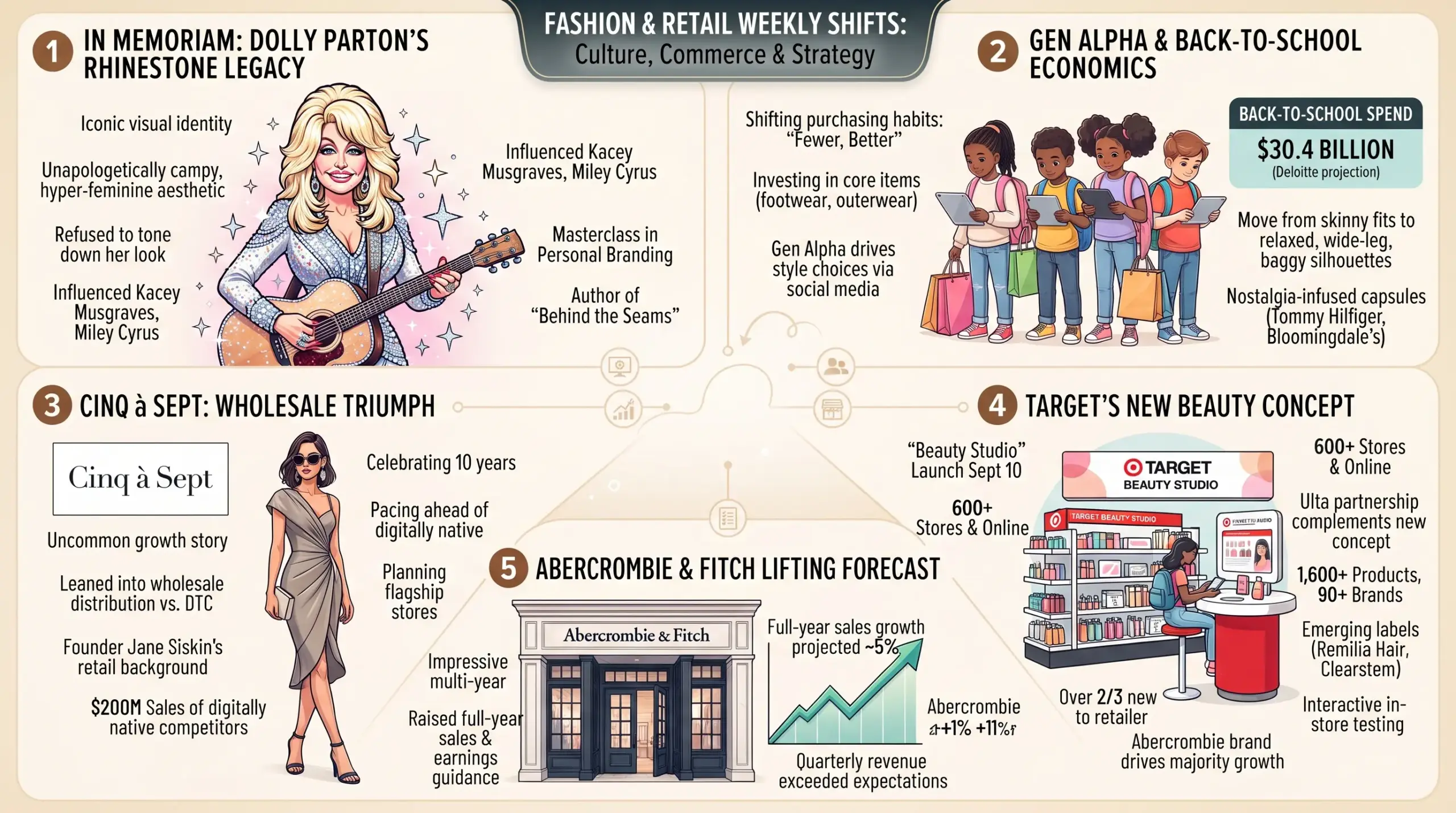
The Enduring Legacy of Dolly Parton’s Rhinestone Aesthetic
The music and fashion worlds are mourning the loss of Dolly Parton, who passed away in Nashville. Over six decades, Parton built an unmistakable, high-octane visual identity that proved as essential to her stardom as her songwriting.
Beginning with her first record deal in 1965, Parton embraced an unapologetically campy, hyper-feminine aesthetic characterized by towering wigs, elaborate embellishments, and custom tailoring. Though early industry executives and peers urged her to tone down her look, she steadfastly refused, transforming her signature style into a masterclass in personal branding. She later cataloged this extensive sartorial history in her memoir, Behind the Seams: My Life in Rhinestones.
Parton’s maximalist vision reshaped how country and pop artists approach stage wear. Her influence remains clearly visible in contemporary performers such as Kacey Musgraves and Miley Cyrus, both of whom have adopted her fearless blending of traditional Americana with glamorous, theatrical flair.
For additional perspective on Parton’s fashion legacy, Vogue’s coverage of Dolly Parton’s fashion rules explores the visual identity that became inseparable from her public persona.
How Gen Alpha and Economic Realities Are Shaping Back-to-School Shopping
Despite broader macroeconomic pressures, back-to-school retail remains a formidable force in the fashion business. A report from Deloitte projects U.S. families will spend $30.4 billion on back-to-school items this season, demonstrating consumer resilience in key apparel categories.
However, purchasing habits are shifting. Parents are opting for a “fewer, better” approach, prioritizing durable investments in core items such as footwear and outerwear. Concurrently, Generation Alpha—the youngest consumer cohort—is exercising significant influence over style choices, fueled primarily by social media trends.
This generational nudge is accelerating a move away from skinny fits toward relaxed, wide-leg, and baggy silhouettes across casualwear. Major retailers are adjusting rapidly: brands like Tommy Hilfiger and Bloomingdale’s are launching nostalgia-infused capsule collaborations while stretching promotional calendars to capture spending across an extended buying period.
For consumers researching online shopping strategies and fashion trends, these changes demonstrate how economic conditions and generational preferences can directly influence what retailers choose to stock and promote.
Brand Growth Strategies: Cinq à Sept and Target’s New Beauty Concept
Two major commercial updates underscore how distinct channel strategies can yield significant retail growth.
Cinq à Sept’s Wholesale Triumph
Contemporary womenswear label Cinq à Sept is celebrating its tenth year in business with an uncommon growth story. While many contemporary labels over-indexed on direct-to-consumer (DTC) channels over the past decade, Founder and Co-CEO Jane Siskin leaned heavily into traditional wholesale distribution—a strategy rooted in her extensive retail background.
The model has yielded major results: Cinq à Sept hit $200 million in sales last year, pacing ahead of digitally native competitors like Hill House Home. As the brand enters its second decade, it plans to expand consumer awareness by opening its first flagship retail locations and partnering with a dedicated creative agency, all while maintaining the product-focused discipline that drove its initial success.
Business of Fashion’s coverage of Cinq à Sept provides additional context on the company’s wholesale-led growth strategy, $200 million in sales, and expansion into standalone retail.
Target Unveils ‘Beauty Studio’
Target is expanding its physical footprint in the beauty category with the launch of “Beauty Studio,” set to debut on September 10 across more than 600 brick-and-mortar stores and online.
Following its high-profile shop-in-shop partnership with Ulta, Target’s new concept will feature more than 1,600 products across 90 curated brands—over two-thirds of which are new to the retailer. Emerging labels, including Remilia Hair and Clearstem, are making their physical retail debuts within the space. To enhance the experience, Target is introducing dedicated beauty advisers, interactive in-store testing stations, and a regularly rotated brand lineup.
Target’s official announcement about Target Beauty Studio confirms the September 10 launch, more than 600 participating stores, 90 brands, and more than 1,600 products.
The launch is also significant for emerging beauty businesses because several brands are using the new format as their first brick-and-mortar retail opportunity. Modern Retail’s coverage provides additional detail on Remilia Hair, Clearstem, and the role of in-store discovery within the new concept.
Abercrombie & Fitch Lifts Sales Forecast Amid Strong Market Demand
Abercrombie & Fitch Co. continues its impressive multi-year turnaround, raising its full-year sales and earnings guidance following another quarter of strong financial performance. Following the announcement, the company’s shares climbed 11% in premarket trading.
The retailer now anticipates full-year sales growth of approximately 5%, up from its previous projections, after quarterly revenue exceeded Wall Street expectations. The flagship Abercrombie brand continued to drive the majority of growth, outperforming sibling chain Hollister—though Hollister experienced a notable seasonal boost from early back-to-school apparel purchases.
Reuters’ coverage of Abercrombie & Fitch’s updated forecast reports that the company raised its full-year sales growth outlook to 5% amid resilient apparel demand and strong performance from its flagship Abercrombie brand.
Looking Ahead
Whether examining the lasting cultural mark of pioneers like Dolly Parton or analyzing the shift toward wide-leg denim and wholesale expansion, success in fashion relies on clear identity and operational agility. As retailers navigate changing demographic tastes and evolving distribution channels, clear positioning remains the industry’s most valuable asset.
For more coverage of fashion, retail, beauty, and online shopping trends, readers can continue exploring the latest industry developments and consumer-focused insights on Pupar Mall.

Related Posts
Elie Saab x H&M Collaboration Lebanese fashion house Elie Saab
ashaki Designing Heirloom Fashion Based in San Francisco, apparel brand

Victoria’s Secret Reports Q2 Sales Spike The global fashion and

The Lede Company Is Hiring a The Lede Company, a
 WhatsApp
 Messenger
 Phone
Phone