
- Victoria's Secret & Co. Delivers Strong Q2 Growth and Elevates Full-Year Guidance
- Wella Company Files for U.S. IPO to Fuel Growth and Balance Sheet Restructuring
- PVH Corp. Reports Q2 Revenue Dip While E-Commerce Maintains Growth Traction
- Azzas 2154 Undoes Merger to Form Two Independent Public Entities
- Experiential Retail Shifts Focus to Unconventional Local Arenas
- Luxury Houses Turn to Fine Artists to Counter Digital Automation
- Industry Outlook: Resilience Through Targeted Strategy
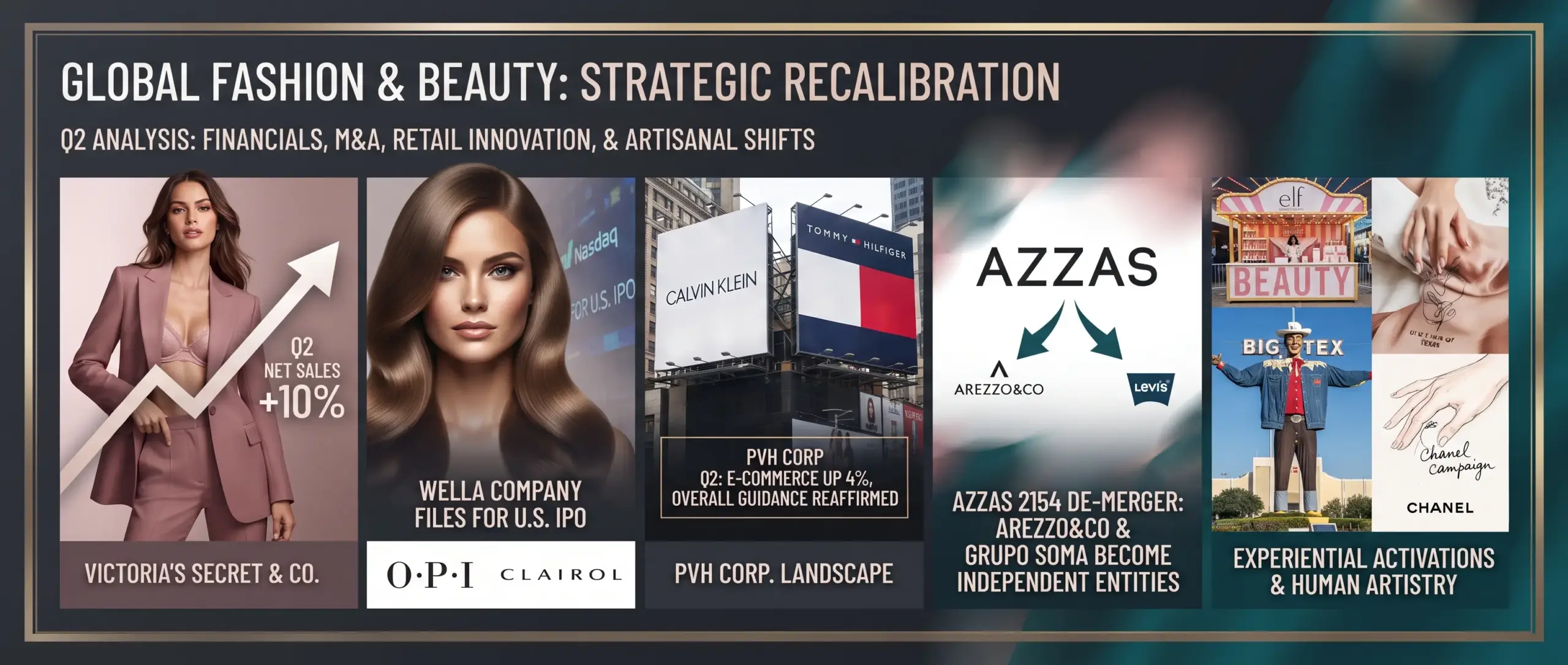 Victoria’s Secret Reports Q2 Sales Spike
The global fashion and beauty sectors are navigating a period of strategic recalibration, defined by shifts in consumer demand, evolving corporate structures, and innovative marketing strategies. Key corporate updates highlight major financial moves across intimate apparel, mass beauty, global heritage brands, and retail activations. From Victoria’s Secret & Co. posting double-digit quarterly gains to Wella Company laying the groundwork for a public market debut, today’s industry landscape showcases a blend of financial resilience, operational realignments, and creative reinvention.
Below is an in-depth look at the top news shaping the fashion business ecosystem, examining income growth, structural corporate separations, dynamic experiential marketing, and creative directional pivots.
Victoria’s Secret & Co. Delivers Strong Q2 Growth and Elevates Full-Year Guidance
In a notable financial update for the intimate apparel sector, Victoria’s Secret & Co. reported a impressive second-quarter performance for fiscal 2026, highlighted by a 10% increase in net sales to $1.61 billion. The surge underscores a solid operational trajectory for the retail giant as it continues to execute its multi-year business transformation.
A major driver of the quarter’s bottom-line performance was the receipt of International Emergency Economic Powers Act (IEEPA) tariff refunds. Victoria’s Secret & Co. received more than $140 million in tariff refunds, representing over 95% of the total IEEPA tariffs previously paid by the company. This substantial capital recovery provided a significant boost to the retailer’s liquidity and financial results for the period.
Upward Revision of Annual Outlook
On the strength of its Q2 net sales growth and improved balance sheet flexibility, Victoria’s Secret & Co. has officially raised its financial guidance for the full fiscal year 2026.
- Updated Net Sales Outlook: $7.10 billion to $7.18 billion
- Previous Net Sales Outlook: $7.03 billion to $7.13 billion
This upward adjustment reflects corporate confidence in maintaining sales momentum throughout the second half of the fiscal year, even amid wider macroeconomic uncertainties impacting global retail markets.
Wella Company Files for U.S. IPO to Fuel Growth and Balance Sheet Restructuring
The professional hair and nail care sector is preparing for a major market event as Wella Company officially filed paperwork for an initial public offering in the United States. Backed by private equity powerhouse KKR, the beauty conglomerate boasts an extensive portfolio of heritage and professional brands, including OPI, Clairol, Sebastian Professional, and Nioxin.
According to its regulatory filings, Wella generated $2.94 billion in revenue for the fiscal year ending June 30, 2026. This represents solid top-line growth compared to the $2.69 billion reported in the corresponding prior-year period, illustrating sustained consumer and professional salon demand across its brand matrix.
Strategic Allocation of IPO Proceeds
The planned public listing represents a strategic move to optimize Wella’s capital structure following its separation from Coty and subsequent equity ownership under KKR. The company disclosed that capital raised from the IPO will be directed toward two primary financial objectives:
- Debt Reduction: Paying down existing corporate debt to lower leverage ratios and interest expenses.
- Tax Obligations: Managing tax liabilities associated with recent corporate restructurings.
By deleveraging its balance sheet, Wella aims to improve operational flexibility and position its flagship hair care and nail care labels for long-term growth in international markets.
PVH Corp. Reports Q2 Revenue Dip While E-Commerce Maintains Growth Traction
PVH Corp., the parent organization behind global lifestyle powerhouses Calvin Klein and Tommy Hilfiger, disclosed its second-quarter financial results, reporting a 3% decline in overall revenue to $2.1 billion. The performance reflects divergent trajectories across its core brand portfolio alongside steady expansion in digital direct-to-consumer channels.
Brand Performance Breakdown
The performance across PVH’s premier labels highlights varied market dynamics across global retail sectors:
- Tommy Hilfiger: Revenue remained approximately flat compared to the same period last year, demonstrating relative stability across wholesale and retail footprint.
- Calvin Klein: Revenue experienced a 7% decline year-over-year, impacted by shifts in global wholesale distribution and regional market demand.
- Digital Channels: E-commerce performance provided a positive highlight, with total digital revenue expanding by 4% across both flagship brands.
Despite the quarterly top-line contraction, PVH Corp. reaffirmed its full-year guidance, projecting overall fiscal year revenue to remain approximately flat compared to the previous year. The strategy signals reliance on direct-to-consumer digital touchpoints and brand-building initiatives to balance wholesale headwinds.
Azzas 2154 Undoes Merger to Form Two Independent Public Entities
In a major structural shift within South American retail, Brazilian fashion group Azzas 2154 announced plans to split its business into two separate, publicly traded companies. The move effectively reverses the strategic merger formed approximately two years ago between Arezzo&Co and Grupo Soma, an ambitious transaction that brought nearly 30 prominent fashion and footwear brands under a single corporate umbrella.
Under the corporate restructuring, the original business entities will chart separate paths forward:
- Arezzo&Co: Will return to operating as a standalone public company, maintaining its heritage emphasis on footwear and accessories.
- Grupo Soma: Soma’s apparel and fashion labels will consolidate into a separate independent public corporate entity.
- Shared Assets: Both independent companies will maintain ownership stakes in Farm Rio, the globally expanded lifestyle label known for vibrant prints and international retail growth.
The corporate split illustrates the challenges of managing large multi-brand conglomerates and underscores a broader retail industry trend toward focused operational agility over broad category consolidation.
Experiential Retail Shifts Focus to Unconventional Local Arenas
As traditional retail marketing channels face saturation, beauty and apparel brands are expanding their physical footprint into unexpected regional cultural events. State fairs, traditionally celebrated for agricultural displays and local entertainment, have emerged as the latest frontier for high-traffic brand activations.
E.l.f. Beauty Captures Mass Audiences with Seasonal Pop-Ups
E.l.f. Beauty demonstrated the potential of fairground marketing during the Minnesota State Fair in August. The brand staged a targeted “real dill”-themed pop-up experience that successfully attracted nearly 64,000 visitors over the course of the event. Capitalizing on that momentum, e.l.f. has secured a formal sponsorship role at the upcoming State Fair of Texas, signaling a sustained shift toward high-volume regional event marketing.
Levi’s Fits Iconic Texan Statue in Tailored Denim
Heritage denim manufacturer Levi’s is similarly expanding its presence at regional events through its official sponsorship of the State Fair of Texas. In a unique marketing initiative designed to generate organic social media engagement, Levi’s is crafting a custom pair of jeans for “Big Tex,” the iconic 55-foot-tall cowboy statue that serves as the official mascot for the historic fair. The high-profile stunt highlights how legacy fashion brands can leverage localized pop-culture iconography to drive brand affinity.
Luxury Houses Turn to Fine Artists to Counter Digital Automation
In an era dominated by rapid advances in generative artificial intelligence and synthetic media, leading luxury fashion houses are deliberately shifting their creative strategies toward traditional human artistry. Brands are increasingly enlisting classical visual artists—including fine painters, sculptors, ceramicists, and illustrators—to craft visual identities for seasonal campaigns and multimedia storytelling.
Hand-Drawn Craftsmanship at Chanel, Dior, and Hermès
Prominent illustrators Karlotta Freier and Sarah Martinon have recently been tapped by top-tier European fashion houses, including Dior, Chanel, and Hermès. The choice to utilize hand-drawn, tactile illustration over computer-generated imagery highlights a luxury strategy rooted in authenticity, artisanal craft, and human touch—qualities that resonate strongly with high-end luxury consumers.
Loewe’s Hand-Painted Cinema Campaign
Demonstrating the scale of artistic collaboration, Spanish luxury brand Loewe executed an ambitious short film composed of 2,000 individual watercolor paintings. Led by illustrator and designer Joanna Blémont alongside a team of 10 visual artists, the project underscores luxury fashion’s ongoing commitment to traditional fine arts as a key differentiator against automated commercial design.
Industry Outlook: Resilience Through Targeted Strategy
The latest updates across the fashion business landscape illustrate a market where agility, authentic messaging, and focused capital allocation remain vital. Whether navigating supply chain shifts, optimizing brand portfolios, or reinventing consumer engagement through local culture and human artistry, companies across the market spectrum are recalibrating their playbooks to secure long-term value.

Related Posts
Elie Saab x H&M Collaboration Lebanese fashion house Elie Saab
ashaki Designing Heirloom Fashion Based in San Francisco, apparel brand

The Lede Company Is Hiring a The Lede Company, a
Julie Kegels Wins 2026 LVMH Prize The global fashion industry
 WhatsApp
 Messenger
 Phone
Phone