
- From Punjab to Corporate Fashion: A Foundation in Craft and Commercial Strategy\
- The Genesis of Arth Atelier: Intentionality and the Incubation Period\
- Demystifying Supply Chains: Transaction Certificates and Traceability\
- Material Innovation, Conscious Sourcing, and Tailoring Efficiency\
- Honoring the Kaarigars: Preserving Multi-Generational Indian Craftsmanship\
- Strategic Growth and International Trajectory\
- The Future of Intentional Ready-To-Wear\
 How Indie Designer Tamanna Mullen Is
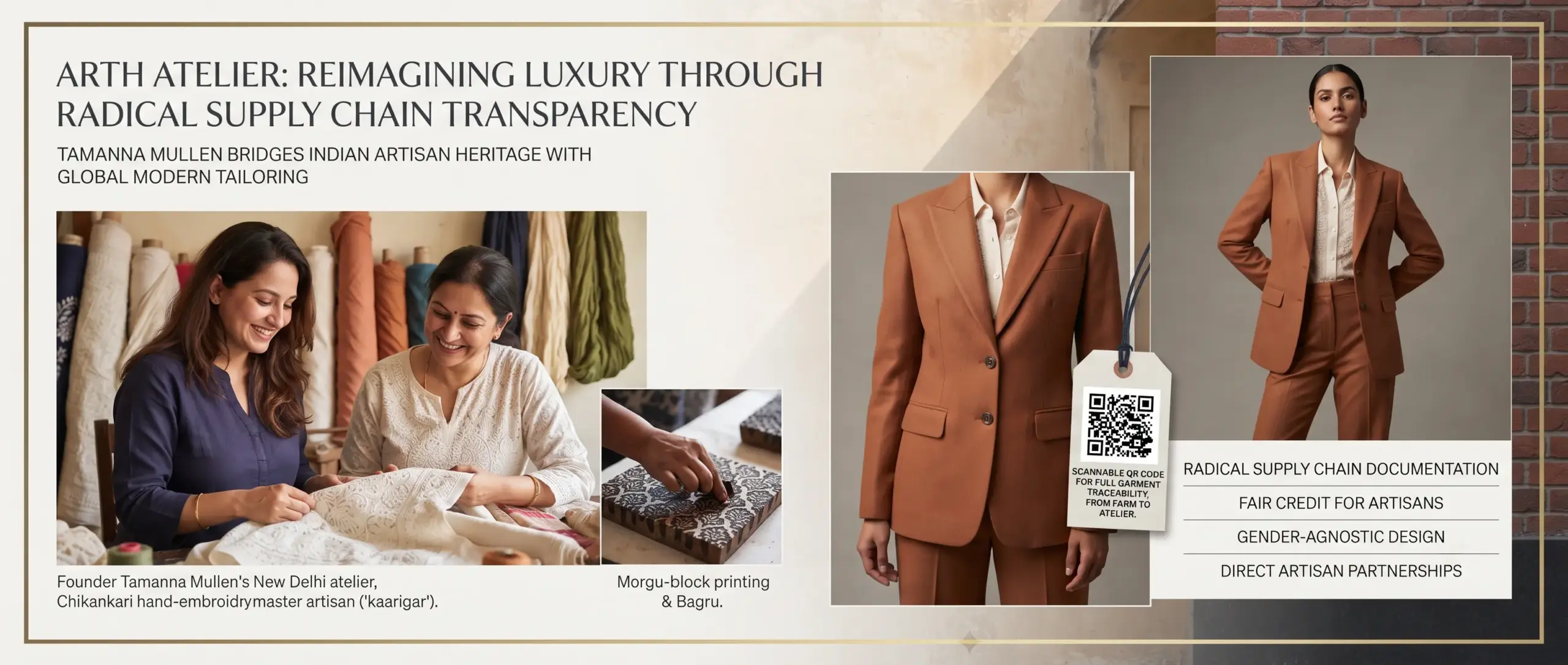
The modern luxury landscape is facing an unprecedented demand for accountability, yet the path to true supply chain transparency remains notoriously difficult to navigate. For Tamanna Mullen, the founder and creative director behind the emerging label Arth Atelier, overcoming these structural industry hurdles has required a complete reimagining of how a contemporary luxury house ought to operate. Instead of adhering to the relentless pace and opaque sourcing methods of corporate fashion, Mullen has chosen a deliberate, slower methodology—one that bridges global modern tailoring with centuries-old Indian artisan heritage.
By grounding her label in radical supply chain documentation, gender-agnostic design, and direct partnerships with traditional craftspeople, Mullen is demonstrating how independent labels can challenge established production norms. Operating between Boston and New Delhi, Arth Atelier presents a fresh, highly intentional model for ready-to-wear, proving that uncompromising ethics and elevated aesthetic rigor can coexist within the global fashion ecosystem.
\
From Punjab to Corporate Fashion: A Foundation in Craft and Commercial Strategy\
Tamanna Mullen’s deep relationship with textiles began long before her entry into the formal fashion industry. Raised in the Indian state of Punjab—a region renowned as a major agricultural and textile manufacturing hub—she was introduced to garment construction and material qualities at an early age. Her family operated as tier-four vendors within the region’s textile hierarchy, exposing her to the raw realities of fabric production, weaving, and garment assembly throughout her childhood. Though she created her initial garment design at age thirteen, cultural expectations surrounding career stability led her to prioritize business studies when she relocated from Punjab to the United States sixteen years ago.
Rather than diverting her from fashion, this commercial education provided Mullen with the analytical toolkit necessary to navigate the complexities of global apparel production. Following her business studies, she entered the corporate fashion sector, building a multi-faceted career that spanned sportswear, streetwear, and commercial ready-to-wear.
During her six-year tenure at Boston-based athletic brand New Balance, Mullen led end-to-end strategy across several prominent collections. In this role, she managed production pipelines, engineered garment construction standards, and directed international fabric sourcing. Her corporate resume also includes strategic roles with major apparel entities such as Savage x Fenty and Victoria’s Secret.
This extensive corporate experience gave Mullen a clear line of sight into the vast scale, speed, and inherent vulnerabilities of mass production. While corporate systems offered invaluable lessons in logistics, supply chain mechanics, and garment engineering, they also highlighted the industry’s widespread reliance on middleman-heavy sourcing and obscure manufacturing networks. Armed with deep operational expertise and an enduring passion for textile craft, Mullen set out to build an independent brand that would directly counter these systemic flaws.
\
The Genesis of Arth Atelier: Intentionality and the Incubation Period\
In 2024, Mullen officially launched Arth Atelier, an independent label designed to offer an uncompromising alternative to standard fast-fashion and commercial ready-to-wear models. The brand’s name reflects its foundational philosophy: “Arth” translates to “significance” or “purpose” in Sanskrit, while “atelier” represents the dedicated space of creative craft. Together, the name serves as a permanent operational anchor, committing the brand to the production of meaningful, enduring, and ethically produced garments.
Rather than rushing directly to market, Mullen dedicated two full years to an intensive incubation phase prior to the brand’s official debut. During this period, she focused on mapping out traceable supply chains and cultivating direct relationships with material producers and regional craft communities. Her research process was exhaustive and hands-on, involving direct consultations with sheep herders, organic agricultural workers, and specialized researchers studying organic farming clusters throughout India.
To secure raw materials that met her exacting criteria, Mullen established key international partnerships. Among these was a collaboration with an Italian textile partner working alongside approximately 200 regenerative farms globally. Through this network, Arth Atelier secured certified wool from specialized producers, including the Piedra Mora Farm in Uruguay, which supplies the raw materials for the brand’s signature knitwear.
Today, the label maintains a dual-continent infrastructure: Mullen remains based in Boston, directing executive strategy and conceptual design, while managing a dedicated atelier in New Delhi, India, where creative development and artisanal production take place.
\
Demystifying Supply Chains: Transaction Certificates and Traceability\
At the heart of Arth Atelier’s business model is a commitment to absolute transparency, operationalized through comprehensive supply chain tracking. Rather than relying on broad, unverified marketing terms, the brand utilizes transaction certificates—formal documentation that verifies the movement and transformation of fibers at every individual stage of manufacturing.
Every garment produced by Arth Atelier includes a physical hang tag equipped with a scannable QR code. By scanning the code, consumers can view the complete step-by-step journey of their specific garment, tracing the raw fiber from its origin farm through textile milling, cut-and-sew assembly, and final hand embroidery.
This granular documentation serves two crucial functions for the modern consumer:
\
-
- \
- \Fair Credit for Artisans:\ It exposes the full spectrum of labor involved in garment construction, attributing technical skill directly to the craftspeople responsible for each stage.\
\
-
- \Consumer Education:\ It illuminates the complex, multi-layered processes required to construct high-end tailored garments, fostering a deeper respect for fine craftsmanship.\
\
Mullen’s transparent approach also directly challenges long-standing international labeling conventions. Under standard rules enforced by trade regulatory bodies like the U.S. Federal Trade Commission (FTC), a garment is permitted to bear a “Made in [Country]” label based solely on where its final “substantial transformation” occurs. Mullen points out that this regulatory standard allows major haute couture and luxury houses to utilize intricate hand embroidery performed by master artisans in India while labeling the final product as made in European fashion capitals like Italy or France. By providing full component-level tracing, Arth Atelier ensures that the contributions of Indian artisans are explicitly acknowledged and credited.
Simultaneously, Mullen maintains an honest stance regarding the realistic limits of supply chain visibility. Acknowledging that standard global supply networks remain fundamentally opaque due to ubiquitous intermediaries, she deliberately avoids claiming absolute, 100% traceability across every single operational component. Furthermore, she actively rejects vague catch-all terminology like “sustainable” in favor of “intentional,” focusing her efforts on building direct, verifiable relationships with highly transparent suppliers.
\
Material Innovation, Conscious Sourcing, and Tailoring Efficiency\
To bypass the opaque networks typical of stock fabric markets, Arth Atelier primarily commissions custom textile developments. By working directly with a carefully vetted, select group of raw material suppliers, the brand maintains tight control over fiber provenance, chemical treatments, and labor practices.
This rigorous vetting process significantly narrows the brand’s pool of eligible suppliers and demands higher financial investment, but it eliminates supply chain gray areas. For instance, the brand relies on a single, highly vetted supplier for its wool requirements, utilizing exclusively 100% certified organic, mulesing-free wool. In tandem with European wool sourcing, Mullen actively experiments with regional Indian botanical fibers, such as banana fiber—a resilient, eco-conscious agricultural byproduct that serves as a high-performing alternative to conventional silk.
The financial realities of custom textile production—including high minimum order quantities (MOQs) and elevated raw material costs—require strategic creative solutions. To maximize material efficiency without sacrificing design integrity, Mullen applies a versatile, gender-agnostic design framework across her collections. Drawing on her extensive background in technical garment construction, she incorporates cross-category detailing across all patterns, such as applying classic menswear buttoning conventions across every piece.
This structural approach yields sharply tailored, fluid silhouettes that appeal across gender identities while allowing the brand to maximize the application of its custom-developed fabrics. Arth Atelier’s ready-to-wear offerings are positioned in the contemporary luxury price tier, ranging from $150 for foundational items to over $700 for complex, heavily embroidered tailored garments.
\
Honoring the Kaarigars: Preserving Multi-Generational Indian Craftsmanship\
Central to Arth Atelier’s creative identity is its direct partnership with \kaarigars\—master Indian craftspeople who possess specialized skills in heritage textile arts. In many regions of India, these hand-embroidery, weaving, and printing techniques represent multi-generational legacies, often passed down through seven or eight generations within specific rural communities.
Rather than centralizing all production within a standard factory setting, Mullen aligns her supply chain with the geographic and cultural hubs of these specific artistic disciplines:
\
-
- \
- \Bagru Block Printing:\ For specialized print textiles, the brand collaborates directly with artisan communities in Bagru, a small town near Rajasthan famed for its traditional hand-block printing techniques.\
\
-
- \Chikankari Hand Embroidery:\ For delicate shadow-work embroidery, such as that featured on the brand’s Chikankari shirts, pieces are dispatched to Lucknow, where female kaarigars execute intricate handwork from home-based artisan collectives.\
\
-
- \New Delhi Atelier Direct Collaboration:\ For specialized structural embellishments and complex garment assembly, small groups of kaarigars are commissioned to work directly within the brand’s central New Delhi atelier.\
\
As contemporary Indian fashion rapidly evolves toward westernized mass production, Mullen views these structured, fairly compensated commissions as a vital mechanism for preserving historic craft techniques. By combining heritage handwork with clean, modern silhouettes, Arth Atelier recontextualizes traditional Indian embroidery as a dynamic, modern medium, appealing directly to a global audience of conscious luxury consumers.
\
Strategic Growth and International Trajectory\
Arth Atelier’s latest collection, titled “Anchored in Motion,” encapsulates the label’s overarching philosophy. Designed for individuals with fluid, global identities, the collection draws aesthetic inspiration from cross-cultural experiences, balancing sharp structural tailoring with delicate hand-applied embellishments.
Following its initial brand launch in 2024, Arth Atelier marked a major milestone by presenting its second collection during a specialized showcase following Paris \Fashion Week\ in June 2026. The presentation signaled the brand’s growing momentum within the international designer fashion market, placing its heritage-infused ready-to-wear alongside established global labels.
Despite this expanding international visibility, Mullen remains dedicated to a measured, ethical growth strategy over aggressive commercial expansion. The brand operates primarily through a direct-to-consumer (DTC) digital framework, which enables direct communication with consumers and supports supply chain transparency initiatives. To selectively expand its global footprint, Arth Atelier has also formed wholesale partnerships with curated multi-brand platforms and boutique retailers that align with its ethical ethos, including Garmentory and Monty.
By maintaining rigorous sourcing standards, honoring multi-generational artisan communities, and pursuing steady, measured expansion, Tamanna Mullen is building a model for independent designer fashion that proves integrity and modern luxury can successfully align.
\
The Future of Intentional Ready-To-Wear\
Arth Atelier represents a necessary evolution in the independent designer sector, demonstrating that true luxury lies in the integrity of the process as much as the final aesthetic. By synthesizing corporate production expertise with deep respect for artisan heritage, Tamanna Mullen has established a resilient framework for transparent, slow-crafted ready-to-wear. As global fashion consumers increasingly demand accountability alongside design innovation, Arth Atelier’s purpose-driven model stands as a compelling blueprint for the future of conscious luxury.

Related Posts

Ib Kamara Exits Off In a major development for luxury

The Lede Company Is Hiring a The Lede Company, a
The Emerging Knitwear Designer Quietly Dressing In the modern landscape
 WhatsApp
 Messenger
 Phone
Phone