
 The Emerging Knitwear Designer Quietly Dressing
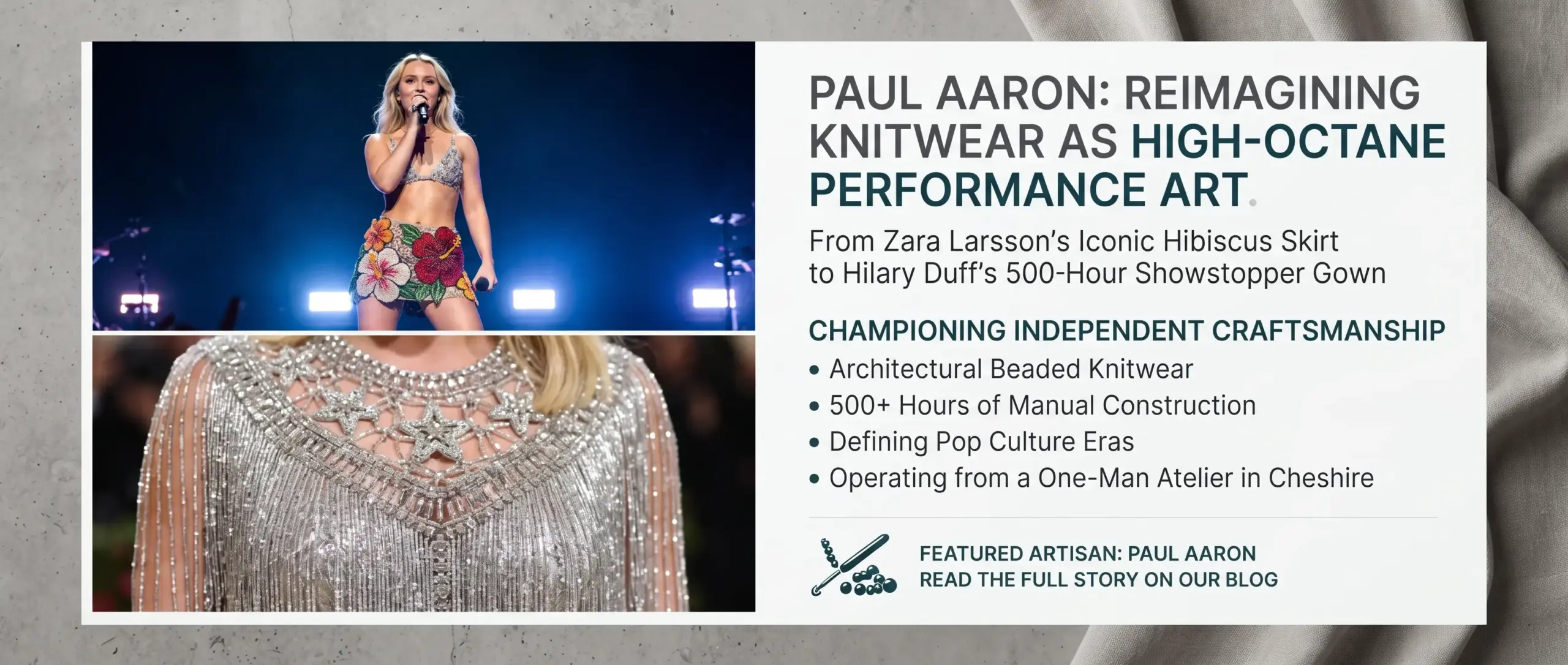
In the modern landscape of celebrity style, stage wardrobes frequently serve as the initial testing ground for defining pop culture eras. When pop star Zara Larsson took the stage in August 2025 as the opening act for Tate McRae’s “Miss Possessive” tour, her performance outfit immediately set the internet ablaze. Wearing an intricately hand-woven mini skirt adorned with beaded hibiscus flowers, Larsson unknowingly debuted what would become the visual foundation for her Y2K-infused “Midnight Sun” era.
Behind that standout piece was Paul Aaron, an independent knitwear designer working out of Cheshire, England. Operating as a one-man atelier, Aaron has become one of the industry’s best-kept secrets, quietly shaping performance wear and red-carpet wardrobes for some of the biggest names in music and pop culture. From crafting high-impact stage looks for Larsson to executing a 500-hour showpiece gown for Hilary Duff, Aaron is challenging long-held assumptions about knitwear by reimagining thread and glass beads into architectural, high-octane performance art.
The Micro-Details of a Tour Showstopper: Crafting Hilary Duff’s 500-Hour Gown
Among Aaron’s most technical achievements to date is a custom tour dress designed for Hilary Duff. Commissioned by Duff’s stylist, Neelo Noory, for the artist’s “Lucky Me” tour, the garment was conceived as an homage to early-2000s partywear, drawing direct inspiration from early Gianni Versace gowns.
The labor-intensive creation required over three months and more than 500 hours of manual construction. To achieve the garment’s balance of structural integrity, fluid movement, and light refraction, Aaron hand-wove more than 20,000 glass beads directly between crocheted star motifs to form the custom base fabric. He then manually embellished the textile with thousands of individual rhinestones and integrated hundreds of meters of heavy crystal chain. The result was a dramatic silver fringe gown engineered specifically to capture stage spotlighting with dynamic kinetic movement.
For the Cheshire-based designer, the collaboration carried personal resonance. Having grown up watching Duff star in Lizzie McGuire, delivering a bespoke performance gown for her national tour represented a meaningful full-circle moment in his evolving career.
Defining Pop Eras: The Zara Larsson Hibiscus Skirt
The impact of custom performance wear often extends beyond a single concert date, occasionally reshaping an artist’s complete stylistic identity. When Larsson performed in Aaron’s beaded hibiscus mini skirt, the piece ignited a broader design trend across her creative team.
Aaron was the original designer to create the specific hand-woven hibiscus floral motifs for Larsson’s wardrobe. Following the initial stage debut, the look quickly became synonymous with the singer’s “Midnight Sun” project. The distinctive visual language established by Aaron’s skirt prompted Larsson’s styling team to subsequently commission additional designers to interpret similar hibiscus-laden aesthetics throughout her promotional appearances and performances.
This immediate ripple effect demonstrates the growing influence of independent artisans within pop tour wardrobes. While major luxury houses often dominate editorial red carpets, emerging craftspeople operating outside major fashion capitals are increasingly driving the core visual narratives of contemporary pop stars.
An Unconventional Route: From Barbie Outfits to Central Saint Martins
Aaron’s path to high-level celebrity design was neither traditional nor linear. His fascination with garment construction began in childhood through dressing Barbie dolls, fashioning mini outfits out of his mother’s repurposed clothing.
His formal entry into fashion occurred largely by chance. When applying for general art and design foundation courses at a local community college, an administrative placement error landed him in a Fashion Design and Textiles program instead. The accidental enrolment sparked a deep interest in raw material manipulation, prompting him to pursue higher fashion education at London’s Central Saint Martins.
Despite the institution’s global prestige, Aaron’s time at.
Central Saint: Martins presented significant systemic challenges. As a working-class student, he faced stark resource disparities compared to better-funded peers. In an industry where garment development often relies on personal financial capital, institutional grants and scholarships intended for lower-income students were sometimes allocated to individuals with pre-existing financial stability. Facing material constraints within the university atelier, Aaron routinely chose to work from home, teaching himself complex, labor-intensive handcraft techniques independently.
Following his graduation in 2020, Aaron focused his practice specifically on handcrafted, beaded knitwear. Driven by a fascination with heavy surface texture, he adopted a tactile philosophy rooted in building garments from scratch. Unlike traditional cut-and-sew apparel design—which relies on manipulating pre-existing woven textiles—knitwear allows a designer to engineer both the fabric and the garment silhouette simultaneously from a single thread.
The Reality of the Independent Atelier
Despite building a high-profile client roster that includes Rita Ora, Shakira, Christina Aguilera, Shenseea, Blackpink’s Lisa, and Kylie Jenner, Aaron continues to run his label as a completely solo operation. He works without assistants, patternmakers, interns, or administrative staff, personally managing every step of the garment lifecycle—from initial raw material sourcing and technical sketching to hand-crocheting, rhinestone setting, and final client fittings.
His first major breakthrough in celebrity styling arrived in 2018, when stylist Karen Clarkson commissioned a custom ensemble for Rita Ora’s headlining performance at Manchester Pride. That high-profile appearance established Aaron on the radar of top-tier celebrity stylists, demonstrating that a single strategic endorsement can validate an independent designer’s technical capability.
However, operating as an unbacked independent artisan presents distinct structural hurdles in today’s fashion landscape:
- Credit Disparities: Emerging designers frequently struggle with a lack of public tag credits and brand exposure when their custom pieces appear in high-profile media or on stage.
- Capital Scarcity: Accessing high-grade raw materials—such as premium glass beads, specialized threads, and crystal chains—requires substantial upfront investment, making profit margins exceptionally slim for self-funded creators.
- Market Saturation: Navigating an overcrowded digital landscape without institutional backing or large-scale promotional budgets presents ongoing challenges for long-term brand visibility.
To navigate these economic realities, Aaron is prioritizing custom direct-to-celebrity commissions while laying the groundwork to secure strategic equity investors before launching a full commercial ready-to-wear label. His immediate focus remains centered on perfecting his manual techniques and systematically expanding his physical studio capacity.
Reimagining Knitwear for the Stage and Beyond
Traditionally categorized as utilitarian, cozy, or cold-weather outerwear, knitwear is undergoing a structural shift driven by independent craftspeople. Aaron’s work represents a deliberate push to elevate hand-knit and crocheted garments into the realm of formal red-carpet couture and durable performance wear.
By combining traditional hand-weaving and crochet methods with high-density glass bead embellishments and heavy metallic hardware, Aaron demonstrates that thread-based garments can deliver the same structural drama, shine, and presence as historic couture gowns. As he continues to build his custom design enterprise from Cheshire, his work offers a persuasive case for the enduring value of uncompromising, patient hand craftsmanship in an increasingly automated fashion industry.

Related Posts
Ib Kamara Exits Off In a major development for luxury
How Indie Designer Tamanna Mullen Is The modern luxury landscape

The Lede Company Is Hiring a The Lede Company, a
 WhatsApp
 Messenger
 Phone
Phone